Legal and accounting practices handle some of the most sensitive client data of any sector, from financial records and case files to personal and commercially confidential information. That makes compliance more than a box ticking exercise, it’s central to client trust and professional obligation. Here’s what GDPR and Cyber Essentials actually require in practice, and where firms most commonly fall short.
Why This Sector Faces Higher Stakes
A data breach at a law firm or accountancy practice isn’t just a technical incident, it can mean breach of client confidentiality, regulatory scrutiny from bodies like the SRA or ICAEW, and reputational damage that’s hard to recover from in a relationship driven business. Firms in this sector are also an attractive target precisely because the data they hold, financial details, case sensitive information, personal records, is valuable to attackers.
GDPR Obligations in Practice
GDPR compliance for legal and accounting firms typically comes down to a few core practical requirements:
- Knowing exactly what personal data you hold, where it’s stored, and why you’re holding it
- Having appropriate technical and organisational measures in place to protect that data, which is where IT security becomes directly relevant to data protection compliance
- Being able to respond properly to subject access requests within statutory timeframes
- Having a clear, tested process for reporting data breaches to the ICO within 72 hours where required
- Ensuring third party suppliers, including your IT provider, handle data in line with your obligations
Where Cyber Essentials Fits In
Cyber Essentials doesn’t replace GDPR compliance, but it provides a solid technical foundation that supports it. The scheme’s requirements around access control, secure configuration, malware protection, patch management, and firewalls address many of the “appropriate technical measures” GDPR expects businesses to have in place. Increasingly, professional bodies and clients in this sector expect to see certification as evidence of a serious approach to data security, not just a GDPR policy document sitting in a drawer.
Common Gaps We See in Practice
Across legal and accounting clients, a handful of issues come up repeatedly:
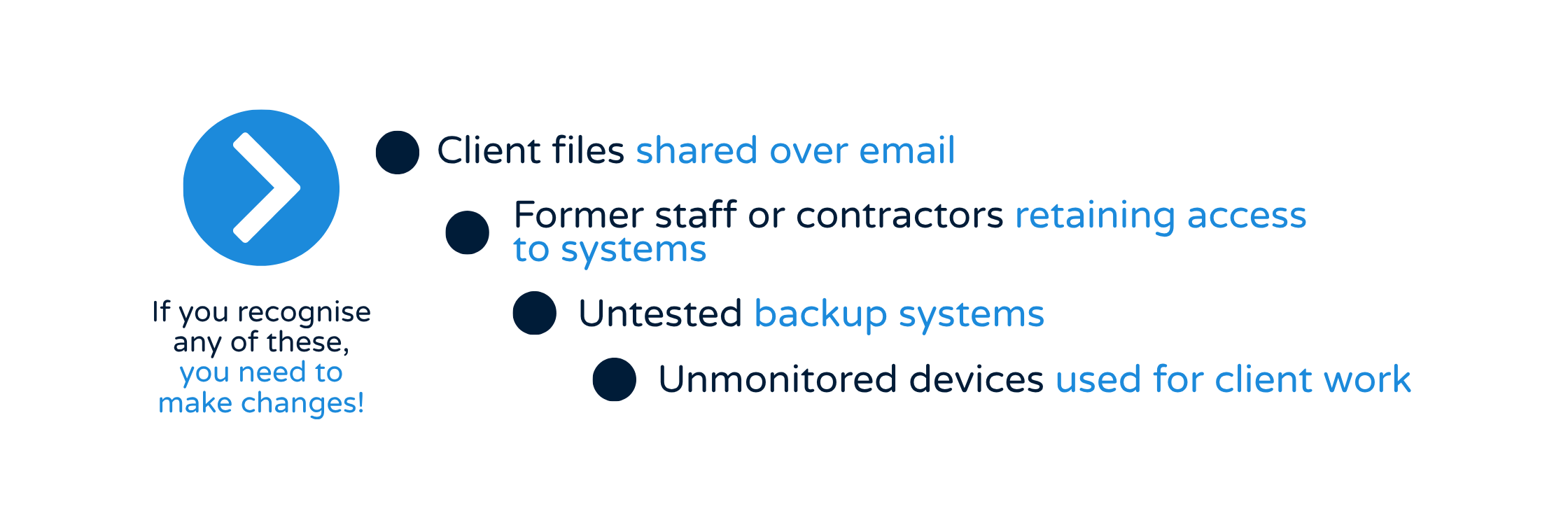
- Client files shared over email or consumer grade cloud storage without proper access controls
- Former staff or contractors retaining access to systems long after they’ve left
- Backup systems that exist on paper but have never actually been tested for a full restore
- Devices used for client work that aren’t centrally managed or monitored, particularly personal devices used for remote working
None of these are dramatic failures on their own, but together they represent exactly the kind of gap an ICO investigation or a disgruntled client complaint would expose.
Building Compliance That Actually Holds Up
The most effective approach treats data protection and cyber security as connected, not separate projects. A properly configured, monitored, and access controlled IT environment does most of the heavy lifting for GDPR’s technical requirements, while clear policies and staff training cover the organisational side.
Get Your Firm Properly Assessed
Disking IT works with legal, accounting, and other regulated professional services firms across Hampshire and Surrey to build IT environments that support both Cyber Essentials certification and wider data protection obligations. Get in touch for a free compliance readiness assessment.

Frequently Asked Questions
🔵 Is Cyber Essentials a legal requirement for law firms and accountants? No, it’s not a statutory requirement, but it’s increasingly expected by clients, professional bodies, and insurers as evidence of a serious approach to data security, and it supports your underlying GDPR obligations.
🔵 How quickly must we report a data breach under GDPR? Where a breach is likely to result in risk to individuals, it must be reported to the ICO within 72 hours of the organisation becoming aware of it, which makes having a tested response process essential.
🔵 Do personal devices used for remote work need to meet the same security standards? Yes. If a personal device is used to access client data or firm systems, it falls within the scope of both your GDPR obligations and Cyber Essentials assessment, and should be managed and secured accordingly.
🔵 What happens if a former employee still has access to our systems? This is a common and serious gap. Unrevoked access after someone leaves is both a data protection risk and a Cyber Essentials failure point, and should be closed off as part of a standard offboarding process.
🔵 Can our IT provider help directly with GDPR, or only with the technical side? A good IT provider can’t give you legal advice on GDPR interpretation, but they can implement and maintain the technical and organisational measures, access control, encryption, backup, monitoring, that your GDPR compliance depends on.
Ready to Check Where Your Firm Stands?
Contact us today for a free compliance readiness assessment, and we’ll show you exactly where your current setup meets the mark, and where it doesn’t. You can contact our team on 0333 038 9060, or email hello@diskingit.co.uk.