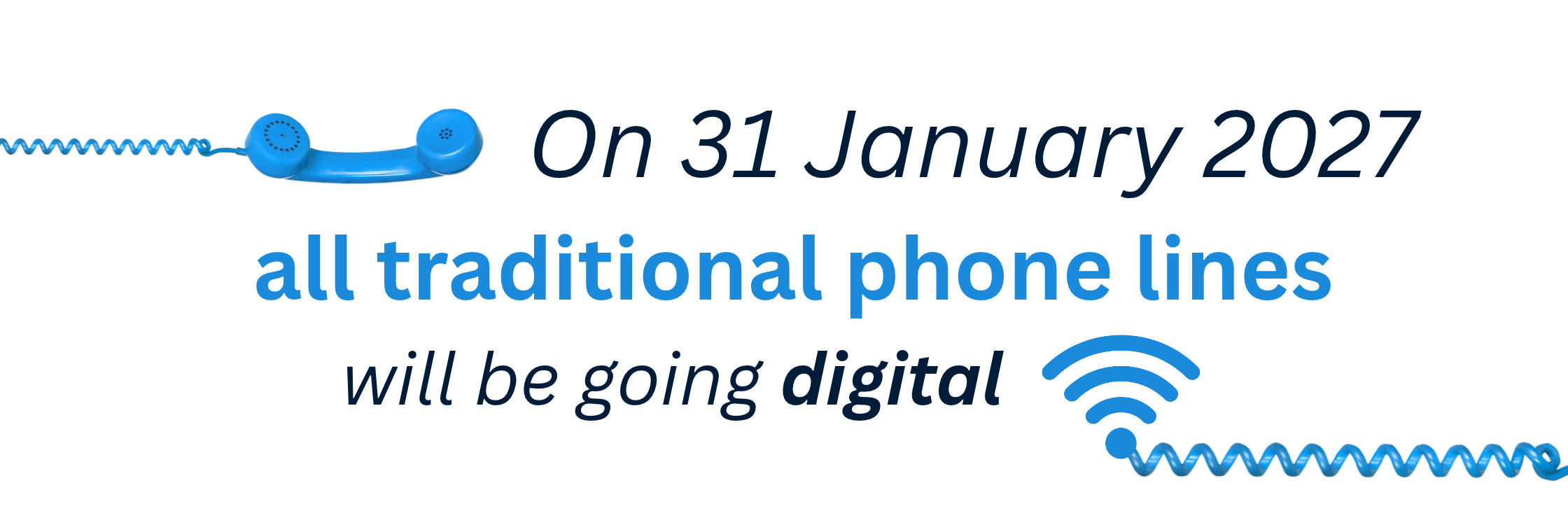
If your business still runs on traditional phone lines, the clock is ticking. Openreach has confirmed the final date for the UK’s Public Switched Telephone Network (PSTN): 31 January 2027. After years of the deadline moving, the network provider has now told communication providers in writing that this date will not be extended again.
That gives most businesses a matter of weeks, not months, to move everything that depends on those lines onto something digital. Here’s what’s happening, who’s affected, and how to get ready.
What is being switched off, and why?
The PSTN is the copper-based analogue phone network that has carried UK landline calls for over a century. Openreach is withdrawing every wholesale product that depends on it, grouped under the umbrella of Wholesale Line Rental (WLR). When the network closes on 31 January 2027, those services stop working, and Openreach will begin decommissioning the remaining legacy equipment.
The reason is that the copper network is old, expensive to maintain, and increasingly unreliable. Digital voice services running over broadband or full fibre are the replacement, and almost every provider has stopped selling analogue lines already.
Which businesses are affected?
It’s not just offices with desk phones. Anything that plugs into a phone line needs attention, including:
- Alarm systems – intruder alarms and redcare-style monitoring lines
- Lift lines – the emergency phones inside lift cars are often on PSTN lines, and building regulations require them to work
- Card payment machines – many still connect over analogue lines
- Fax lines – still common in healthcare, legal and logistics
- Door entry and gate systems – often quietly connected to a phone line
- Franking machines, CCTV backhaul and environmental monitors
Devices that you didn’t realise were on a phone line in the first place are the things which will catch you out. That’s why an audit comes first.
Your options
Cloud telephony with 3CX. This is our recommended route for most businesses. 3CX is a modern cloud phone system that replaces your old lines with calls made over the internet. You get a full business phone system: call queues, voicemail-to-email, auto-attendants, call recording, and apps for mobile and desktop, at a fraction of the cost of a traditional PBX.
Keeping your existing numbers. Almost every worry we hear starts with “will I lose my number?”. The answer is no. Your numbers can be ported to a cloud telephony service, so customers, suppliers and long-printed stationery carry on as normal.
For alarm and lift lines. These often need specific digital replacements or managed conversions rather than a simple port. We can identify them and handle each one properly.
A short readiness checklist
- Find your lines. Check your phone bills for every line and service you pay for. Ask: what is actually plugged into this?
- Walk the building. Lifts, alarms, card terminals, door entry, fax machines. If it has a phone socket, it’s affected.
- Talk to your providers. Confirm with your alarm company and lift maintenance firm what they need post-switch-off.
- Pick your phone system. Decide between cloud telephony and other options before the January rush.
- Book the migration. Ports and installations take time, and January capacity is filling up fast.
The benefits for hybrid working…
With 3CX, your team can make and receive business calls from their laptop or mobile, wherever they’re working. A call to the office rings on a home worker’s laptop. A customer calls your main number and reaches whoever is available. Receptionists aren’t chained to a desk phone, and nobody misses a call because they’re on a site visit.
How much does it cost?
Cloud telephony is typically cheaper than maintaining analogue lines, with per-user monthly pricing and no PBX hardware to maintain. The exact cost depends on your user count and the features you need, which is why we start with a review rather than a quote.
 FAQs
What is the PSTN switch-off?
The permanent closure of the UK’s analogue telephone network by Openreach on 31 January 2027. Every service that depends on traditional phone lines will stop working, and the date has been confirmed as final.
Can I keep my phone number?
Yes. Existing numbers can be ported to cloud telephony services. Porting takes planning, so start early.
Will my alarm system still work?
Not on a PSTN line, no. Some modern alarms can move to digital lines or mobile connectivity, but older systems may need replacement or upgrading. Check with your alarm provider now.
How much does cloud telephony cost?
Usually less than you’re paying now, priced per user per month. A telephony review will give you exact figures for your setup.

Ready to get off the PSTN?
Book a free telephony review with Disking IT. We’ll audit every line and connected device, tell you exactly what’s affected, and map out a migration plan that gets you switched over well before the deadline, without losing a single number.