If you think your business has not “started” using AI yet, there’s a good chance you’re wrong. Somewhere in your team right now there’s AI at work – someone is probably drafting an email with ChatGPT, summarising a meeting with an AI note taker, or asking a chatbot to tidy up a proposal before it lands in a client’s inbox.
That’s not necessarily a bad thing. Used well, AI is one of the most useful productivity tools to arrive in years, and small and medium sized businesses stand to gain as much from it as any large enterprise – often more, because the time saved matters more when your team is small.
The problem is what happens in the gap between “AI is useful” and “AI is being used safely.” That gap is where most SMEs currently sit, usually without realising it.

Practical AI use cases SMEs are already getting value from
Before we get to the risks, it’s worth being clear about why staff are reaching for these tools in the first place. None of this is exotic. These are the everyday jobs AI is taking off people’s plates:
Customer service and first line support. AI powered chatbots and email triage tools can handle routine customer questions, log tickets, and route anything complex to a human, cutting response times without adding headcount.
Marketing and content drafting. Blog posts, social copy, product descriptions and email campaigns can all start life as an AI first draft, with a human editing for accuracy and tone before it goes out.
Meeting notes and admin. AI note takers can join calls, produce summaries and action points, and save the person who used to do this manually a genuinely significant chunk of their week.
Document and data processing. Invoice processing, contract review, and pulling data out of PDFs or spreadsheets are all jobs AI tools now do faster and more consistently than manual entry.
Reporting and forecasting. AI built into modern accounting and business tools can spot trends in cash flow, sales, or stock levels far quicker than someone building a spreadsheet by hand.
Recruitment and HR support. Screening CVs, drafting job descriptions, and handling first line HR queries are increasingly AI assisted tasks that free up time for the parts of HR that genuinely need a person.
Used deliberately, with the right tools and the right oversight, all of this is a straightforward productivity win. The trouble is that most of it isn’t happening deliberately at all.

The security risk nobody talks about
Most of the AI security conversation focuses on AI as a weapon: criminals using AI to write more convincing phishing emails, or build malware that adapts on the fly. That’s real, and worth taking seriously. But it’s not the risk most likely to catch your business out this year.
The bigger, quieter risk is shadow AI: employees using AI tools you haven’t approved, don’t know about, and have no control over, often with your business’s or your customers’ data.
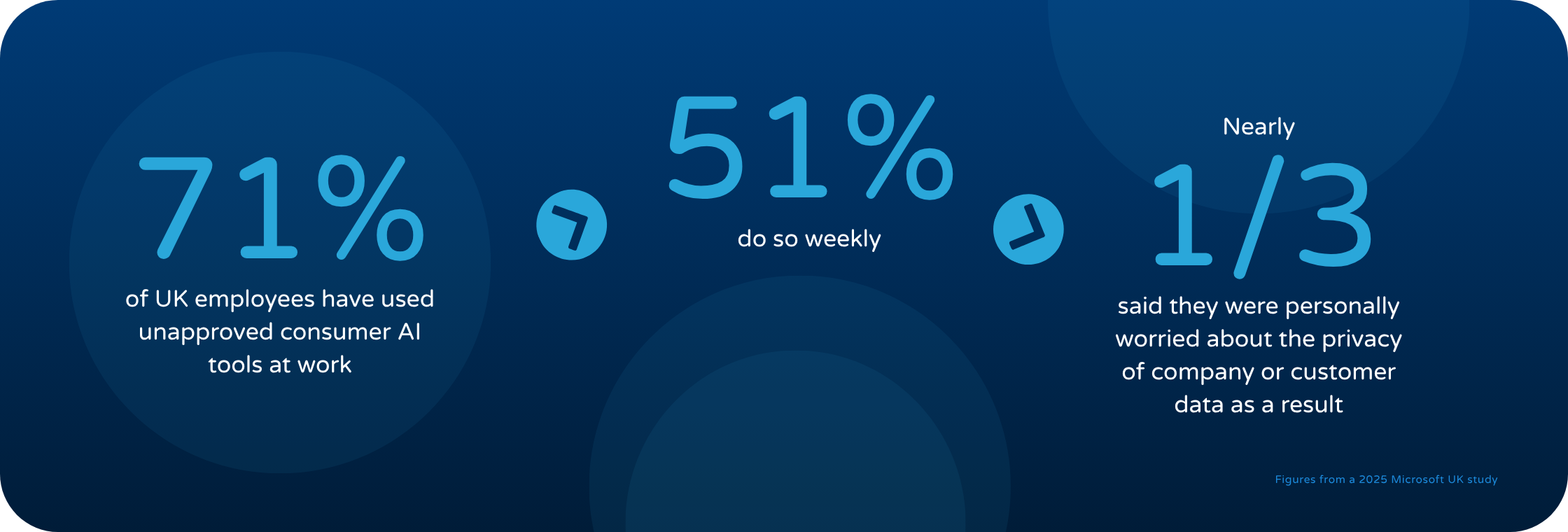
The numbers back this up. A 2025 Microsoft UK study found that 71% of UK employees have used unapproved consumer AI tools at work, and 51% do so weekly. Nearly a third said they were personally worried about the privacy of company or customer data as a result, and almost as many were concerned about the impact on IT security.
It’s not reckless behaviour, either. Most staff using these tools are simply trying to get their job done faster. They’re not thinking about where that customer list, contract, or set of financial figures goes once it’s pasted into a free AI tool, who can see it, or how long it’s retained.
That matters more than it might seem. IBM’s 2025 Cost of a Data Breach Report found that shadow AI was a factor in 20% of breaches at organisations that had one, adding an average of $670,000 to the cost of the breach. The same report found that 97% of organisations with an AI related security incident had no proper access controls in place, and 63% had no AI governance policy at all. Small businesses are not exempt from any of this. If anything, the lack of a dedicated IT or security team often makes SMEs more exposed, not less.
There’s also a compliance angle UK businesses can’t ignore. The ICO has been clear that UK GDPR obligations apply to how personal data is used with AI tools, regardless of whether that use was formally approved by the business. If a member of staff pastes a customer’s personal details into a public AI tool, that’s your business’s data protection responsibility, whether you knew it was happening or not.
What SMEs can actually do about it
The instinct to simply ban AI tools is understandable, but it rarely works. Staff who feel blocked tend to find a way round it, often on personal devices where you have even less visibility. A more realistic approach looks like this:
- Find out what’s actually being used. You can’t manage what you can’t see. A short, honest conversation with your team (or a proper audit) usually reveals more AI use than leadership expects.
- Set a simple AI usage policy. This doesn’t need to be a 40 page document. It needs to say clearly what data can and can’t go into AI tools, and which tools are approved.
- Give people a sanctioned alternative. If the free version of a tool is what’s driving adoption, a properly licensed, business grade equivalent with better data protections removes most of the temptation.
- Classify your sensitive data. Staff can’t avoid putting the wrong information into an AI tool if they don’t know what “sensitive” actually covers in your business.
- Train, don’t just police. A short briefing on what can go wrong, and why, does more than a policy nobody reads.
- Get proper governance in place. For most SMEs, this is where outside expertise pays for itself: a clear AI usage policy, the right access controls, and a governance framework that satisfies both common sense and UK GDPR.
Getting the benefit of AI without the exposure
None of this is a reason to avoid AI. The businesses getting real value from it aren’t the ones locking everything down, they’re the ones who worked out what their teams needed, gave them a safe way to get it, and put sensible guardrails around the rest.
That’s exactly what our AI Security, Policy & Governance service is built for: helping SMEs understand where AI is already being used in their business, put the right policy and controls around it, and adopt the tools that actually help without creating a data protection headache. If you’re not sure how much AI is already inside your business, that’s usually the first thing worth finding out.